Deep Learning is the most exciting and powerful branch of Machine Learning.
Geoffrey Hinton is the god father of Deep Learning. Is a British-born Canadian cognitive psychologist and computer scientist, most noted for his work on Artificial Neural Networks. As of 2015 he divides his time working for Google and University of Toronto.
Deep Learning models can be used for a variety of complex tasks:
How Deep Learning Models are formed in Computer:
Our mind is a collection of billion-billion neurons, which take input from various sensors (eyes, nose etc) and process the input thru these neurons and generate output/decision.

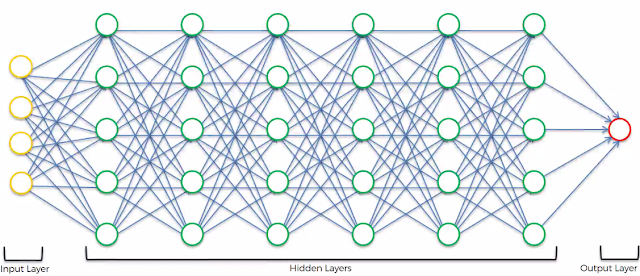
Replication of above, is taken as below in computer to form Deep Learning Model.
Hope this helps!!
Geoffrey Hinton is the god father of Deep Learning. Is a British-born Canadian cognitive psychologist and computer scientist, most noted for his work on Artificial Neural Networks. As of 2015 he divides his time working for Google and University of Toronto.
Deep Learning models can be used for a variety of complex tasks:
- Artificial Neural Networks for Regression and Classification
- Convolutional Neural Networks for Computer Vision
- Recurrent Neural Networks for Time Series Analysis
- Self Organizing Maps for Feature Extraction
- Deep Boltzmann Machines for Recommendation Systems
- Auto Encoders for Recommendation Systems
- Artificial Neural Networks for a Business Problem
- Convolutional Neural Networks for a Computer Vision task
How Deep Learning Models are formed in Computer:
Our mind is a collection of billion-billion neurons, which take input from various sensors (eyes, nose etc) and process the input thru these neurons and generate output/decision.

Replication of above, is taken as below in computer to form Deep Learning Model.

Hope this helps!!
Arun Manglick

Great explanation of how different deep learning models like ANN and CNN work — it really clarifies the fundamentals of Deep Learning for beginners! It would be even more helpful if you could expand on real-world applications and best practices for training these models. For businesses looking to implement advanced ML solutions, services like ML Development Services
ReplyDeleteand Deep learning Services can really accelerate project success by applying optimized models to real problems.